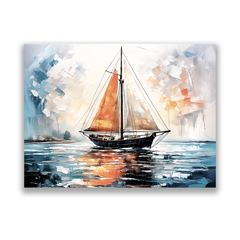
Collection: Dining Room Coastal Art Collection

The dining room wall is the one you actually look at. Not in passing, not half-asleep on your way somewhere else — you sit across from it for the length of an entire meal. Sunday dinner, a holiday with twelve people crammed around an extended table, a Tuesday night with takeout and the news on low. However long you're sitting there, that wall is what's in your sightline the whole time.

Some dining rooms are their own enclosed space — four walls, a door, a formal dining room that exists just for sitting down to eat. Others are part of open layouts, visible from the kitchen or the living room at the same time you're setting the table. Either way, dining room wall art has a harder job than people give it credit for. It's not background. It's not something you glance at on your way somewhere else. It's the view.

A dining room often gets seen by people who don't see the rest of the house — the in-laws at Thanksgiving, new neighbors at a dinner party, the friend who only ever visits for book club. That wall ends up doing more first-impression work than almost any other wall in the house, whether you intended it to or not.

This collection of dining room art brings coastal beauty into a formal dining area or an open-concept dining space without asking you to match anything. Serene landscapes for the wall above a buffet. Smaller pieces for a cozy breakfast nook or a kitchen wall art corner you've been meaning to fill. A bold centerpiece for the wall you face during long mealtime settings, or a small gallery wall effect made of two or three dining room prints if one piece feels like too much commitment.

Pieces with deeper blues and richer tones tend to anchor a formal dining room, the kind of space mostly used for holidays and special occasions. Lighter, sandier pieces work well in a breakfast nook or an everyday dining space that sees homework and coffee as much as dinner. Either way, this isn't about chasing dining room décor trends or building a coordinated "look." It's wall accents and art pieces that happen to live in a dining room, not home decor or interior design performing for guests who might walk through — just whatever makes the dining experience feel like yours.

You don't need modern aesthetics, a color palette that matches your table runner, or a curated range of artwork chasing some finished look. What you need is the right piece for that wall — the right artwork is whatever you actually want to see, whether dinner is a special occasion or just everyday living with the dog under the table.

There's a right tone for every dining room, and the best wall art for it isn't dictated by a decorator's checklist. It's whatever feels like the perfect piece once you're sitting across from it, plate in hand, for however long the meal takes.

More to explore:

This dining room wall art collection keeps growing, and it's just one part of a larger collection of dining room wall art and coastal pieces across the site.
Read about choosing dining room wall art.
Browse staircase coastal art, or learn how to hang artwork above the couch

Browse all coastal wall art


Dining Room Coastal Art Collection

If you're choosing between a few pieces and can't settle on one, that's normal — most people sit with this decision longer than they expect to. Best sellers is a reasonable place to start if you want a lower-risk option; the most popular pieces tend to be popular for a reason. But there's no wrong answer here as long as it's something you'll actually want to look at during dinner, not something that just matches the room.

And if it gets hung and it's still not right — wrong size, wrong tone for the room, just not the one — you've got 30 days to send it back for a full refund. Email customer service at support@stridecoastal.com with your order number and we'll start the return. Return shipping is on you, but there's no restocking fee, and your refund goes through within five business days of it arriving back here. You're not locked into a decision made from a phone screen at 11pm after the dishes are done.

There's no perfect dining room wall — there's just the one you actually want to look at while you eat. Hang it at the height you see it from your chair, size it to the furniture below it if there is any, and let it be the one that holds up to getting stared at every single day. That's the whole decision, and it's the only one that matters here.

See the size guide for help choosing size and placement.

Diane redid her dining room three different times before she gave up trying to make it "cohesive." New curtains. A different runner. A mirror that was supposed to bounce light around the room and instead just bounced back the same blank wall it was trying to fix. She moved the mirror to the hallway. The dining room wall stayed empty.

It wasn't even a room they used every day — more holidays, the occasional Sunday dinner, the kids' birthday parties that always ended up at the table because the living room couch couldn't hold everyone. But every time people sat down to eat, that wall was right there, doing nothing. She remembers her book club meeting at her house once — eight women sitting around that table for two hours, Diane wondering if anyone else even noticed the blank wall, or if it was just her.

She saw Evening Shore on her phone one night, scrolling after the dishes were done. The driftwood, the sunset — the kind of piece she'd have called "a little much" for the living room. For the dining room, the room where people actually sit and look at the same spot for an hour at a time, it felt right.

She almost ordered the smaller size. Safer, she figured, for a wall she wasn't totally sure about — smaller meant less to commit to if she changed her mind. But smaller also meant the piece would float on a wall that wide, the way a postcard floats on a barn door. So she taped up the Best Size Strips at the size she actually wanted first, the bigger one, and sat at the table with her coffee the next morning just to see how it felt — her eye level, sitting down, not standing in the doorway sizing it up. It held the wall in a way the smaller one wouldn't have.

She ordered it that day. On the smaller wall by the buffet, she added two square pieces from the seashell collection — nothing matching, just things she liked looking at while the table got set.

When it arrived, she hung it before dinner, then texted a photo to her sister with no caption. Her sister wrote back: wait, did you redo the whole room? She hadn't. She'd just finally found the one piece that made the rest of it stop mattering.

Now it's the wall she stares at every single mealtime — cereal some mornings, homework spread across the table some afternoons, the actual holiday dinners it was bought for. She didn't plan the room around it. The piece is just what's there, every time she sits down.

The decision that trips people up on a dining room wall isn't really about the art — it's about height. Most hanging rules tell you to center a piece at eye level, but they're built for a hallway or a living room, where you're standing when you look at it. A dining room is different. You're sitting down almost every time you actually look at that wall — coffee in the morning, dinner at night, homework in the afternoon. The eye level that matters here is seated eye level, not the standing-height number every general decor guide repeats.

Here's the actual test: sit in the chair you actually use most, and look straight ahead at the wall. That's the height that matters — not 60 inches from the floor, not the center of the wall. If your dining room doubles as a passthrough people stand in too — open-concept space, kitchen sightline — you can split the difference slightly higher, but seated eye level should still be the anchor, not an afterthought.

Size works the same way it does over a sofa or a buffet: scale to the furniture below it, not the whole wall. If you're hanging above a buffet or sideboard, aim for roughly two-thirds to three-quarters of that piece's width — too small and it floats, too wide and it overwhelms the dining furniture it's paired with. A standard buffet runs somewhere between 60 and 72 inches wide, which puts the art in roughly the 40-to-54-inch range — one large piece, or two medium ones hung close together. If there's no furniture below, just a clear run of wall facing the table, size to the wall itself and lean a little bigger rather than smaller. A piece you see from across a table reads smaller than one you're standing right next to.

If your 'dining room' is actually a breakfast nook or a kitchen table that doubles as the only eating space you've got, the same height rule still applies — sit, look, hang it there — but skip the bold centerpiece. A smaller, single piece reads better in a tight space than something sized for a full dining room. Save the gallery wall effect for when you've got more wall to work with.

If you're working on your living room instead, read here.

You can find the full Refunds Policy here.

This is original coastal artwork, reproduced as archival canvas and ready to hang with wall-mounting hardware included — not high-quality paper prints you'll find everywhere else, in spaces of all sizes from a small accent piece to a large centerpiece for the wall. New pieces show up throughout the year too — not seasonal style ideas that rotate in and out, just fresh collections added whenever a new one's ready.

Stride Coastal canvas prints ship within the United States only, and you'll get free shipping every day on orders over $50. 

Want first access to special offers and new pieces? Click here to join our mailing list. You can find our privacy policy here.